
Star Wars Zero Company campaign planning guide
Plan a Star Wars Zero Company campaign planning routine around Cycles, injuries, Intel, Operations, Bonds, expiry timers, and Den preparation.
The direct answer
Plan a Star Wars Zero Company campaign one Cycle at a time. Before launching the next Tactical Mission, use The Den to check injuries, conversations, facilities, recruits, equipment, Intel, Operations, Bonds, and the objective on the Holotable. A Tactical Mission advances the campaign to the next Cycle, so a good plan finishes the preparation that cannot wait.
The campaign does not reward a blind race through the main story. Operations and Missions can expire, personal tasks can depend on conversations, and an injured Operator may change the squad available for the next battle. The exact total number of Cycles in every release campaign is To be confirmed, so plan around visible timers and objectives instead of an unverified finish number.
What a Cycle controls
A Cycle connects the strategic map to a Tactical Mission. The campaign routine moves from The Den, through the Holotable and its Operations, to one tactical deployment that advances time. This is a useful planning model even when a run takes a different optional branch.
At the beginning of a Cycle, list the board options. Mark the story-critical objective, the Operations with timers, the Hero or personal missions tied to an Operator, and the Tactical Mission that will end the Cycle. Then decide which result matters most before you spend resources or commit the squad.
Both Operations and Missions can expire, while story-critical missions become obligatory after a period of time. That makes the visible timer more important than a generic checklist because the board may not offer the same option after the next deployment.
Start with The Den
The Den is the company’s base on the Ring of Kafrene. Use it to speak with Operators, manage recovery, review the roster, work with available facilities, and prepare the next deployment. Conversations can reveal backstories and unlock missions with personal meaning, so check the social side of the base before leaving for combat.
The Holotable is the decision surface. It presents strategic Operations and Tactical Missions, while the mission panel shows the current objective and available squad context. Read the panel fully because a short label may omit a protected target, a required Operator, a resource cost, or a later extraction phase.
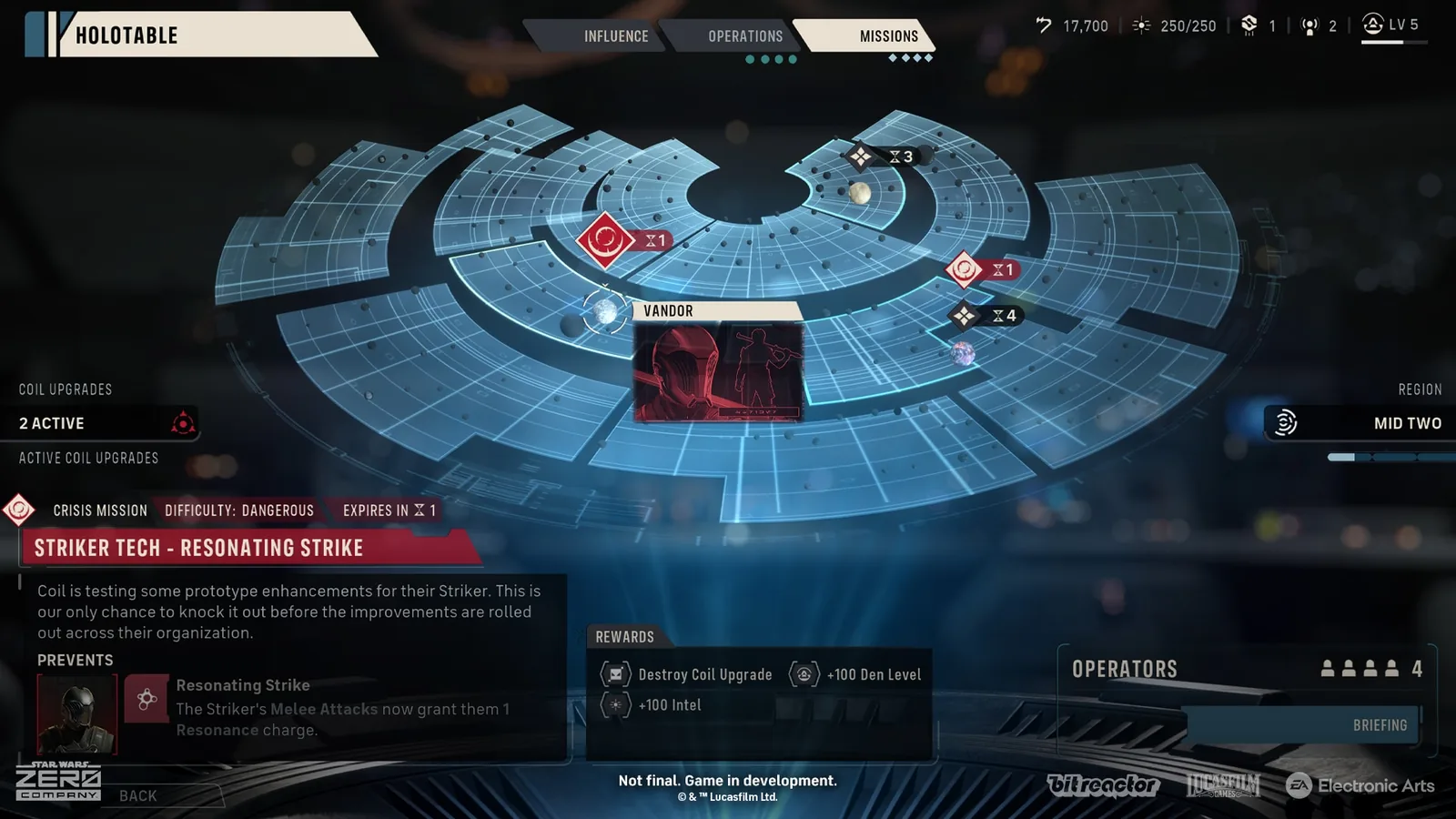
Do not launch with a damaged squad merely because the mission is available. Injuries can reduce combat performance or keep an Operator out of the next deployment, while healing can consume time. The best choice depends on the objective, the backup roster, the timer, and the reward shown in the current state.
Compare Operations with the next mission
Operations are non-combat assignments that can spend Intel and return an immediate reward, narrative information, or an unlock. Some can change Bonds or side-mission availability through a dilemma. Check what the Operation costs and what it changes before deciding that a Tactical Mission is automatically the highest-value action.
Intel should be treated as a limited planning resource. Spending it can open a reward or information route, but saving it may preserve access to another Operation. The total Intel supply, the cost of every branch, and the final economy of the campaign are To be confirmed unless the current panel shows them.
Influence, Credits, Capacitors, healing, Bond progress, and facility development can compete for the same Cycle. A reward is only useful when it answers the company’s current problem. Compare it with the next mission’s difficulty, the Operators who need to deploy, and the Den upgrade or relationship goal you are trying to protect.
Build the squad around the objective
Read the mission objective before choosing the four-person deployment. A rescue or extraction mission needs movement, healing, and protection for non-standard units. A defense or sabotage mission needs a way to hold a lane while the interaction completes. An elimination mission needs enough damage and control to handle reinforcements that count toward the final clear.
Each Operator normally has three Action Points. Movement, attacks, abilities, and Overwatch use the same pool, so the squad should include a plan for the first move and the enemy turn. Advantage is shared, which means the team should decide which special action changes the objective rather than spending every point on the first available attack.
Keep relationship goals visible when the roster allows it. The game links conversations, Bonds, and some Operation choices to the wider campaign. Do not promise a specific Bond result when the current state does not show one, and mark the full level and reward rules To be confirmed.
A safe Cycle routine
At the start of the Cycle, inspect The Den and the Holotable. Read every objective, record the timers, check Operators and injuries, compare Intel costs, and decide whether any conversation or facility action must happen before deployment. Only then select the Tactical Mission that will move the clock.
During the mission, protect the objective and stop fighting when the route is clear. The squad does not need to defeat every enemy unless the objective explicitly requires it. At the result screen, note injuries, resource changes, Bonds, and the next board before making the next plan.
If the first route fails, the mission can be restarted from the menu. Restarting is useful for learning objective phases and preserving a required Operator. It does not settle the consequences of every failure state, so keep those outcomes marked To be confirmed.
What not to fix in advance
Do not force the campaign into a fixed total of Cycles when the available route details do not establish one. Do not treat more than 150 strategic worlds as more than 150 tactical battle maps. Do not assume that every Operation changes a Bond or that every optional mission remains available after a story deployment.
Campaign planning works when it stays close to the current board. Read the objective, protect the squad that can actually complete it, spend Intel with a reason, and treat the next Cycle as a consequence of the mission you are launching now. The remaining release-wide route details are To be confirmed.
Related articles
missions
Star Wars Zero Company Storm Basin Mission Guide
Learn how the Storm Basin rescue mission works in Star Wars Zero Company, including the Runa trigger, six civilians, six-turn objective, and route limits.
missions
Our Jedi Friend Operation Guide
Find the verified Our Jedi Friend choices, requirements, Intel cost, availability, and Smugglers' Den connection in STAR WARS Zero Company.
missions
Star Wars Zero Company Anaxes mission guide
Explore Star Wars Zero Company Anaxes missions, including Buy Cheap, Never Sleep, Kabb's required objective, Holotable access, rewards, and failure checks.
Was this helpful?
Thanks for the feedback.